 Carbon Trading
Nepal's Carbon Trading Regulation 2082: A Complete Explainer
What This Blog Covers
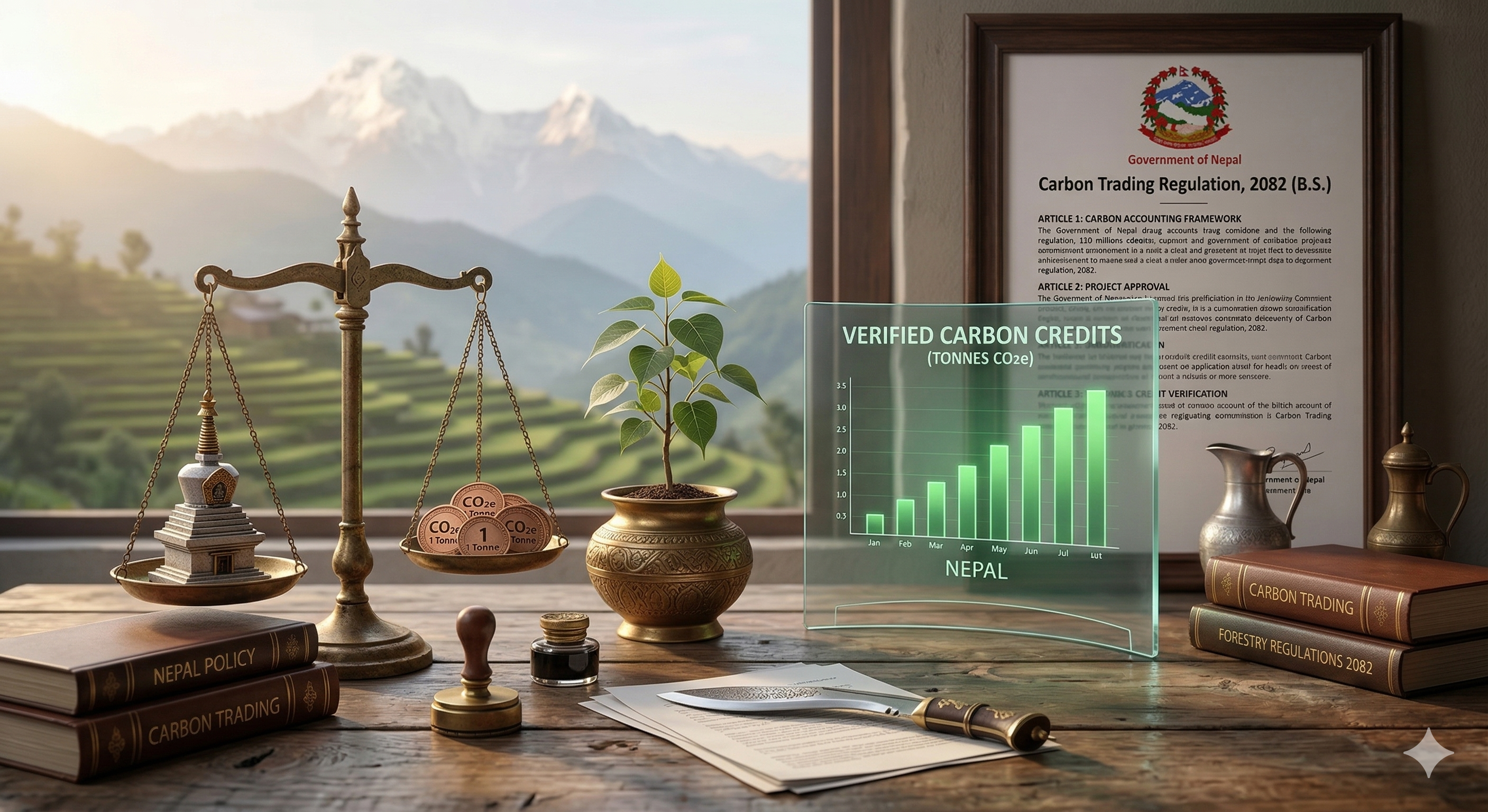
Nepal's Carbon Trade Regulation 2082 — endorsed in late 2025 — is the country's first comprehensive legal framework for developing, registering, and trading carbon credits under both the Paris Agreement (Article 6) and the Voluntary Carbon Market (VCM). This post explains: who can participate, which sectors are eligible, what trading modes exist, and what it costs.
Why This Regulation Matters
Until now, Nepal lacked a single, operational legal structure for carbon markets. Existing policies — the Environment Protection Act (2019), the Forest Act (2019), the National Climate Change Policy (2019) — all pointed toward carbon finance but left critical gaps: no clear approval pathway, no standardized benefit-sharing rules, and no mechanism for international buyers to trust the integrity of Nepal's credits.
The Carbon Trade Regulation 2082 fills all of this. It creates clear procedures, defines eligible sectors, sets financial terms, and — critically — implements the corresponding adjustment mechanism that international buyers demand for Article 6 transactions.
|
NEPAL'S CARBON POLICY FRAMEWORK — HIERARCHY |
|
|
1 |
Constitution of Nepal Art. 30 (Right to Clean Environment) · Art. 51 (State Policies) |
|
2 |
National Climate Change Policy (2019) 80% climate finance to local level · Carbon registry mandate |
|
3 |
Environment Protection Act (2019) Authorized GoN to participate in international carbon trading |
|
4 |
Long-term Strategy for Net-zero 2045 (2021) Carbon market as key GHG mitigation tool · Article 6 pathways |
|
5 |
★ Carbon Trade Regulation 2082 (2025) Operational framework: approval, MRV, trading, benefit-sharing |
Who Can Participate?
The regulation defines eligible Proponents (Prastawak) broadly, opening the market to a wide range of actors:
|
# |
Participant Type |
Details |
|
1 |
Registered Companies |
Any company registered within Nepal |
|
2 |
Joint Ventures |
JVs between foreign and Nepali-registered companies |
|
3 |
Government Bodies |
Federal, provincial, and local governments (with proper consent) |
|
4 |
NGOs & Private Sector |
Can implement non-market projects with ministry permission |
Eligible Sectors
The regulation applies to six key sectors — a broad scope that captures most of Nepal's clean development opportunity:
|
ELIGIBLE SECTORS UNDER CARBON TRADE REGULATION 2082 |
|
|
⚡ Renewable Energy |
Hydropower, solar, wind, biogas, and small/community energy systems |
|
🍳 Energy Efficiency |
Industrial efficiency programs and clean cooking stoves (urban & rural) |
|
🌳 Agriculture & Forestry (AFOLU) |
Afforestation, REDD+, sustainable forest management, natural regeneration |
|
♻️ Waste Management |
Waste-to-energy, landfill gas capture, resource recovery |
|
🚌 Transport |
Electric vehicles, EV infrastructure, sustainable public transport systems |
|
🌏 Adaptation & Resilience |
Green economy, biodiversity conservation, food/water security projects |
Four Modes of Carbon Trading
1. Paris Agreement Crediting Mechanism (Article 6)
Trading under the mechanisms established by the 2015 Paris Agreement — Article 6.2 (bilateral ITMOs between countries) and Article 6.4 (the centralized UN-run Sustainable Development Mechanism). This is the highest-value pathway for international buyers, requiring the corresponding adjustment.
2. Voluntary Carbon Market (VCM)
Proponents can sell credits to private entities outside government compliance schemes. Carbon credit prices are determined by negotiation between buyer and seller — market dynamics apply. This is accessible even without bilateral government agreements.
3. Bilateral Government-to-Government (G2G)
The Government of Nepal can trade directly through international treaties, bilateral agreements with foreign governments, or agreements with foreign institutions and the private sector. B2B trade is also permitted under specific treaty terms.
4. Domestic Carbon Market
An internal voluntary carbon market within Nepal, governed by Ministry-approved guidelines. Government bodies, the private sector, and other entities can participate domestically without engaging international mechanisms.
Financial Obligations for Proponents
Understanding the financial structure is critical before entering any project. Here is the complete breakdown of payments to the Government of Nepal:
|
Payment |
Rate / Amount |
Type |
Notes |
|
NDC Deduction |
5% of all credits |
Non-cash |
Deducted from credit inventory toward Nepal's NDC |
|
Sales Fee |
NPR 100 per ton |
Cash |
On remaining 95% sellable volume |
|
Benefit Sharing |
10% of profit |
Cash |
Private sector only; GoN projects → Consolidated Fund |
|
Project Fee (Small) |
NPR 25,000 |
One-time |
For projects <20,000 tCO₂/year |
|
Project Fee (Medium) |
NPR 50,000 |
One-time |
For projects 20,000–60,000 tCO₂/year |
|
Project Fee (Large) |
NPR 100,000 |
One-time |
For projects >60,000 tCO₂/year |
|
Income Tax |
As per Tax Act |
Corporate |
Standard tax liabilities apply |
Key Takeaway: After the 5% NDC deduction and NPR 100/ton sales fee, the remaining 95% of credits can be traded. Private sector proponents then share 10% of the profit (not revenue) with the government — leaving strong upside for well-structured projects.
The Corresponding Adjustment: Why It's a Game-Changer
For any international transfer under Article 6.2, Nepal's Designated National Authority (MoFE) executes the corresponding adjustment — subtracting sold credits from Nepal's NDC registry and adding them to the buyer's registry. This single mechanism is what makes Nepal's credits credible to international buyers who need assurance against double-counting.
Without this provision, Nepal's credits would struggle to command premium prices in global markets. With it, Nepal is now positioned to attract serious institutional buyers from Europe, Japan, and beyond.
About Laxmi Clean Tech
At Laxmi Clean Tech, we develop carbon projects across Nepal's clean energy and efficiency sectors. The Carbon Trade Regulation 2082 transforms our operating environment — giving our projects a clear legal foundation, defined approval timelines, and international market access. Whether it's clean cooking, distributed solar, or biogas — the opportunity is now structured, legal, and investable.